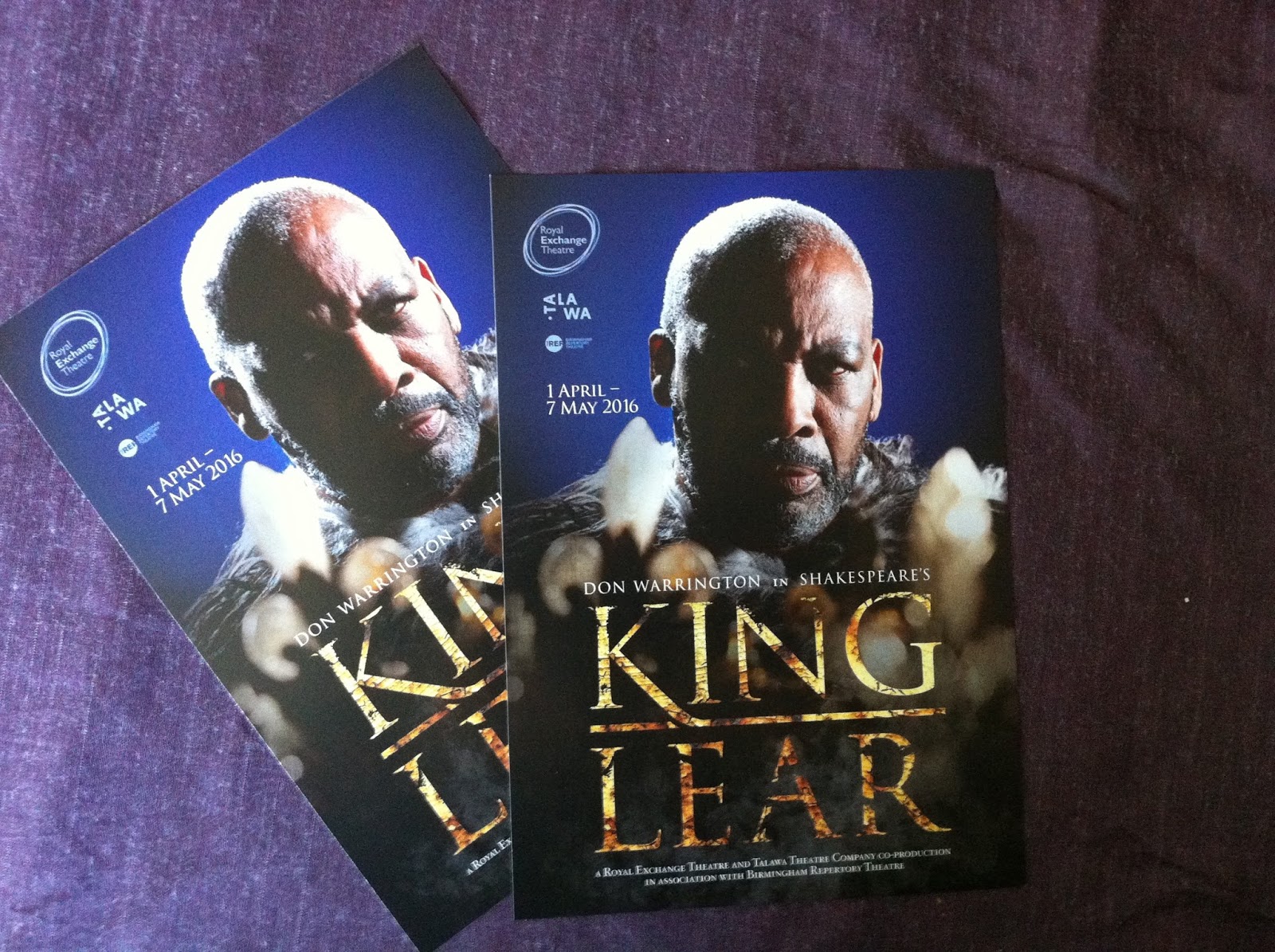
Performed at the Royal Exchange Theatre,
Manchester and directed by Michael Buffong.
A Royal Exchange Theatre and Talawa Theatre Company co-production, in association with Birmingham Repertory Theatre.
King Lear is one of those plays which I have read but until now, not seen performed on stage. It was an impressive show and the tension was kept up throughout the whole of the three hours production. I particularly liked the simple set which consisted of a disc shape, set within a circle and muddy brown in colour, like the bare earth. I had not picked up on the designer's vision that it would be reminiscent of an eye, echoing the recurrent themes of blindness and the ability of some to perceive. I did appreciate how flexible the space was, alternating between the interior of a castle or out of doors in the wild.
Don Warrington gave a powerful performance as the King who
descended into madness. Imposing at the beginning, he conveyed the authority which he had used to rule the kingdom up to that point. Flawed by his arrogance, he made a poor decision in rejecting Cordelia, his favourite daughter, because she would not flatter him in the way her sisters, Goneril and Regan were able to do. With the kingdom given over to the two remaining daughters, we saw chaos descend and witnessed Lear's sanity begin to crumble.
Most striking was the scene of the storm when the heavens opened, literally and the rain lashed down. Men seemed totally insignificant against the elements and all the order and civilisation of Lear's court had gone. There was excellent use of the space outside the auditorium with the sound effects of baying dogs and shouting pursuers. You really felt as though they were all just outside but closing fast.
The violence when Gloucester's eyes were gouged out was truly shocking and the audience winced. The ability of characters to see went beyond the physical however. People had to find the 'right' way ahead and be able to perceive beyond the literal. Some, such as Kent were shocked at Lear's inability to 'see' through the hypocrisy of Regan and Goneril. One did not have to be actually blinded to be oblivious to events or motives. In all, I found the play lived up to my expectations. Individuals were excellent. I would have liked to see more obvious edge and attitude from Regan and Goneril but their game was more subtle than that. If I had to single somebody out, other than Lear, it would be Fraser Ayres who played Edmund, the wily, illegitimate son of Gloucester, with such panache. Also, Miltos Yerolemou, as Lear's Fool, was an excellent foil for his master, as Lear's protector and conscience.
In short: a challenging look at how society and the individual can descend into chaos.




Comments
Post a Comment